



Too many businesses treat discounting as a quick close tactic. The problem is that a price cut is not free. It changes the commercial maths, the delivery burden and, often, the behaviour of the customer you are trying to win.
The result is simple: if the discount is not tied to a clear commercial objective, it tends to weaken profit faster than it improves growth.
That matters for owners, finance leaders and commercial teams because price is rarely just a sales decision. In a well-run business, it is part of the commercial model. It affects margin, cash, service load, customer expectations and the quality of future growth.
For technical businesses, engineering firms, energy-sector suppliers and B2B service providers, the risk is even sharper. A small discount may look harmless on paper, but once you add mobilisation, supervision, travel, support, rework or after-sales attention, the real margin can vanish quickly.
The commercial question is not whether discounts should exist. They should, in specific situations. The real question is whether the business is applying them deliberately, with a measurable objective and a clear exit point.
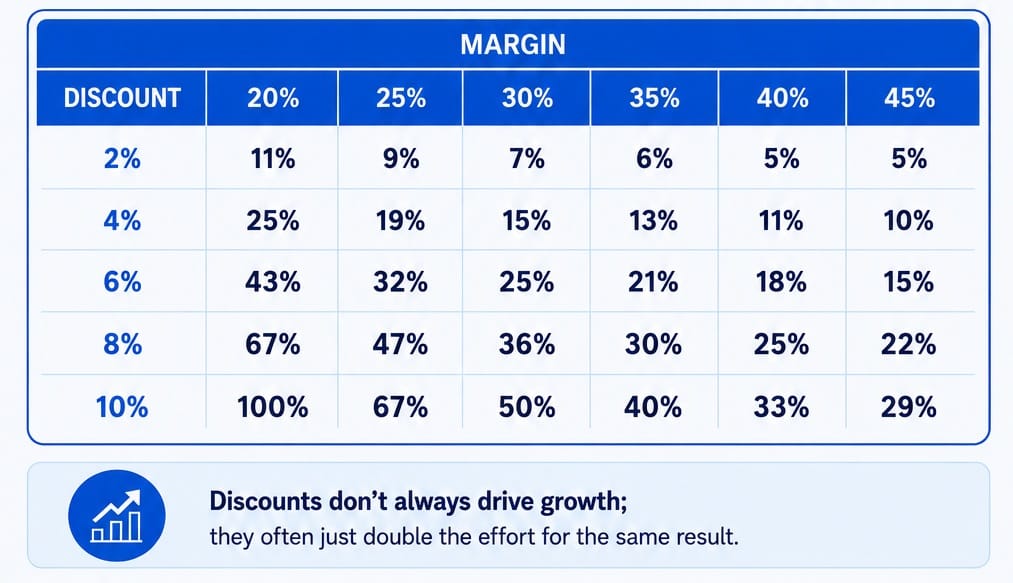
The arithmetic most teams skip
Gross margin is the right starting point because it shows how much profit is left after direct costs. Investopedia defines gross margin as the percentage of revenue retained after direct expenses such as labour and materials are subtracted. CFI uses the same basic logic in its gross margin ratio explanation.
That matters because a discount does not just lower revenue. It reduces the profit you make on every sale.
If you sell at £100 with a 40% gross margin, your gross profit is £40.
Offer a 10% discount and the price drops to £90. If the cost base stays the same, gross profit falls to £30.
To make the same total gross profit, you would now need 33.3% more sales.
The same pattern appears lower down the margin stack. If your gross margin is 20% and you give a 4% discount, gross profit per sale falls from £20 to £16. To stand still, you need 25% more sales.
Those are not abstract percentages. They are the amount of extra work the business has to do just to keep profit flat.
Why discounting is so attractive
Discounting feels easy because the benefit is immediate and visible. The objection goes away. The quote gets out. The renewal looks safer. The buyer feels they have won something.
But what often happens next is less convenient:
- the customer learns to ask for a reduction every time;
- the sales team starts leading with price instead of value;
- the business attracts more price-sensitive work than it can comfortably support;
- margin becomes harder to rebuild later.
That is why discounting is usually a commercial behaviour issue, not just a pricing issue.
When a discount can be commercially justified
Discounts are not always wrong. They can make sense if the business can explain the purpose clearly.
1. Entering a market or segment
A controlled discount can help a business earn a first reference, test a new channel or remove friction in a market-entry phase. That is different from discounting because the buyer simply pushed harder than the sales team.
2. Defending a strategic account
There are times when retaining a key customer is worth a carefully measured concession. But the logic should be explicit. What is being protected? Margin, volume, pipeline access, product adoption or relationship value?
3. Trading one margin for another
A discount can be sensible if it unlocks a larger, more profitable follow-on opportunity. For example, a lower-margin pilot may be acceptable if it leads to a recurring service contract, a wider deployment or a longer-term framework agreement.
The point is that the discount must be tied to a named commercial outcome. If nobody can state the outcome, the discount is probably just leakage.
What this means for business leaders
This is where pricing discipline becomes a leadership issue.
In value-led businesses, price is part of the strategy. It signals positioning, confidence, target customer profile and the quality of the offer. If pricing is handled casually, the wider commercial model becomes harder to control.
That is especially true in sectors where delivery costs are not trivial. An engineering consultancy, energy supplier, software provider or industrial services firm can lose much more than headline margin if a discount encourages extra scope, slower payment, more support or a more demanding customer relationship.
Commercial leaders should be asking:
- What problem is this discount solving?
- What profit are we giving up?
- What volume, retention or cross-sell uplift is needed to justify it?
- What happens if the customer expects the same treatment next time?
If those questions are not answered, the business is making a tactical concession without a strategic reason.
Practical actions that improve pricing discipline
The answer is not to ban discounts entirely. It is to make them harder to justify and easier to measure.
- Set a minimum margin floor by product, service line or segment.
- Require approval for any non-standard discount above a defined threshold.
- Test the volume uplift needed before agreeing to a concession.
- Time-limit the discount and attach it to a specific objective.
- Review win rate, realised margin and customer behaviour after the deal closes.
If the deal only works because the headline price was reduced, the sales process still needs work.
TriBus view: commercialisation with discipline
This is a commercialisation issue at heart. TriBus works with technically strong businesses that do not need more noise, more activity or more generic selling. They need sharper propositions, clearer routes to market and a stronger commercial model.
Pricing sits inside that model.
When discounting is disciplined, the business can protect value, defend margin and keep growth sustainable. When it is habitual, the organisation often ends up working harder for less return.
That is why pricing decisions should be treated with the same seriousness as segmentation, offer design and route-to-market planning. They are all part of the same commercial system.
The most useful question is not, “Can we knock something off?”
It is, “What business result are we buying, and is it worth the margin we are giving away?”
That is a far better place to start.
Sources and further reading
- Gross Margin: Definition, Example, Formula, and How to Calculate – Investopedia – https://www.investopedia.com/terms/g/grossmargin.asp
- Gross Margin Ratio – Corporate Finance Institute – https://corporatefinanceinstitute.com/resources/accounting/gross-margin/