


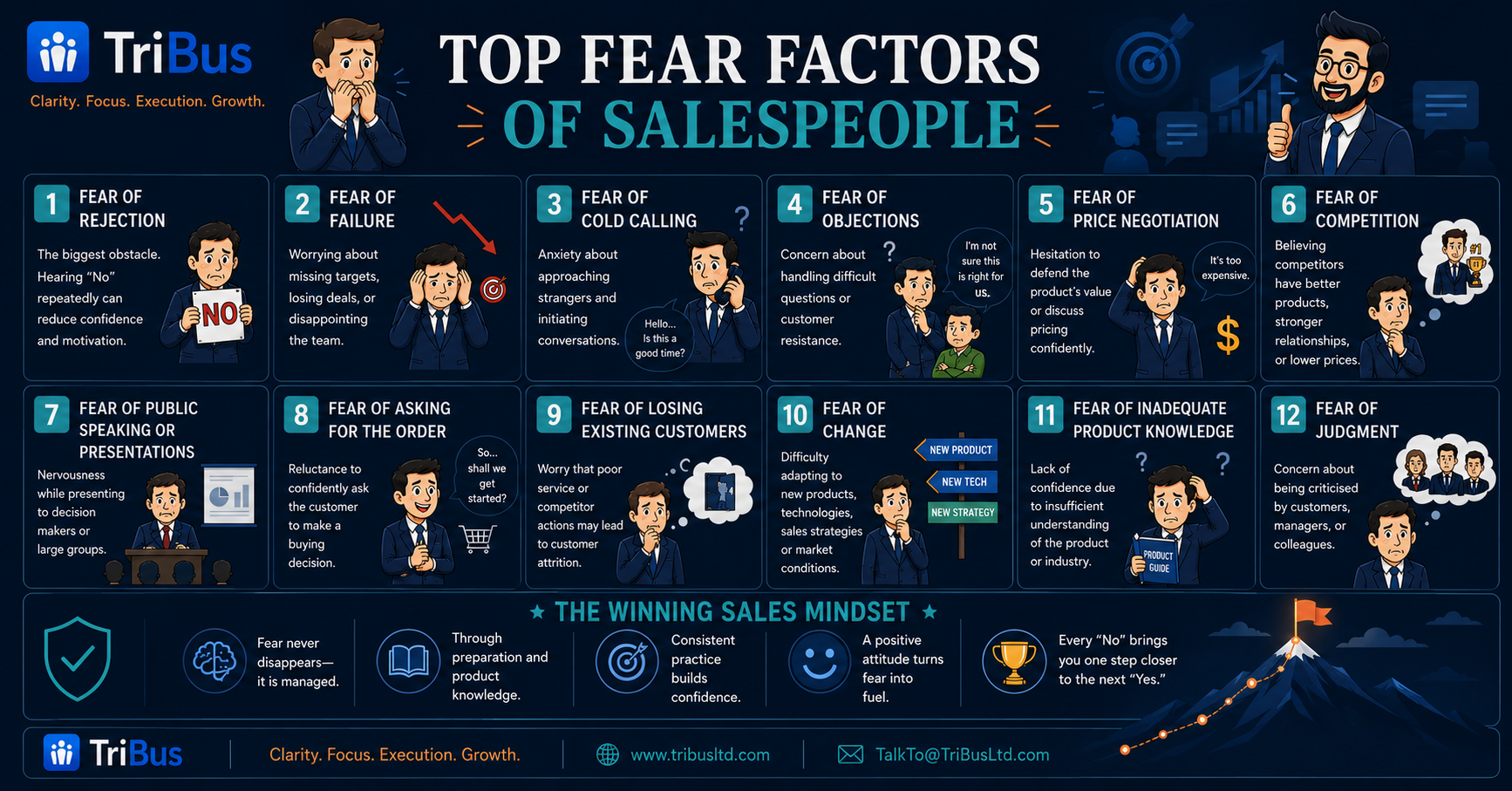
The biggest barriers in sales are not always found in the market. They are often found in the behaviour a salesperson adopts when uncertainty appears.
For business leaders, the real commercial issue is not whether salespeople experience fear. Most do.
The issue is whether that fear begins shaping how opportunities are approached, qualified, negotiated and closed.
Research into salesperson social anxiety has linked anxiety around customer and employer evaluation with weaker communication, protective behaviours and poorer sales performance. It also suggests that support from sales managers can help people manage that pressure more effectively.
That matters because fear rarely presents itself as fear.
It appears as delayed follow-up, unnecessary discounting, overpreparation, weak qualification or reluctance to ask a direct question. The salesperson may still look busy, but the commercial process begins to lose momentum.
For leadership teams, the warning signs are often visible long before anyone admits they lack confidence.
Fear changes sales behaviour
In practice, the common fear factors are easy to recognise:
- Fear of rejection
- Fear of failure
- Fear of cold calling
- Fear of handling objections
- Fear of discussing price
- Fear of competition
- Fear of presenting to senior decision-makers
- Fear of asking for the order
- Fear of losing an existing customer
- Fear of change
- Fear of inadequate product knowledge
- Fear of being judged
None of these concerns automatically makes someone a poor salesperson.
The problem begins when the fear starts deciding what happens next.
A salesperson who fears rejection may avoid making the call.
Someone uncomfortable with objections may accept the customer’s first response without exploring what sits behind it.
A person nervous about price may offer a discount before the customer has asked for one.
Someone worried about losing an existing account may avoid challenging poor terms, weak margins or unrealistic expectations.
These may appear to be small behavioural choices, but their commercial effect can be significant.
They influence pipeline quality, conversion, margin, forecast accuracy and the amount of management time spent supporting opportunities that were never properly qualified.
Fear of rejection can become call reluctance
Salespeople hear “no” more frequently than most other employees.
That rejection may relate to timing, budget, existing relationships, internal priorities or a simple lack of fit. However, when each response is treated as a personal judgement, confidence can quickly decline.
The behaviour that follows is often more damaging than the rejection itself.
The salesperson may:
- delay prospecting;
- repeatedly research the same account;
- focus on familiar customers rather than new opportunities;
- rely too heavily on email;
- avoid senior decision-makers; or
- wait for the perfect reason to make contact.
The useful question is not:
Why did they reject me?
It is:
What did the response tell us about the opportunity?
A rejected approach can still provide useful information about timing, customer priorities, positioning and market fit.
Every “no” should improve the next conversation.
Fear of failure can weaken the pipeline
Sales targets are visible.
Revenue, activity, conversion and pipeline value are all measured, which can make missed performance feel highly personal.
That pressure can encourage salespeople to hold on to opportunities that no longer deserve their time.
A weak deal remains in the forecast because removing it would reduce the pipeline.
A customer who has stopped responding is described as “still considering”.
A proposal with no clear decision date is treated as an active opportunity.
The result is a pipeline that creates confidence on paper but provides little commercial certainty.
Leaders should not remove accountability. However, they should make it safe for salespeople to report an opportunity honestly.
A lost or disqualified deal should prompt practical questions:
- Was the customer a genuine fit?
- Was the problem important enough to solve?
- Did we engage the right decision-makers?
- Was there a confirmed budget and timetable?
- Did the customer understand the commercial value?
- Was the opportunity ever genuinely qualified?
Accurate information is more valuable than an optimistic forecast.
Fear of cold calling is often a positioning problem
Cold calling feels difficult because the salesperson is initiating a conversation without knowing how the other person will respond.
The pressure increases when the call is treated as an immediate sales pitch.
A first conversation does not need to close the sale.
Its purpose is normally to:
- establish relevance;
- understand whether a meaningful problem exists;
- identify whether the timing is right; and
- agree whether a further discussion would be worthwhile.
Preparation matters, but excessive scripting can make the conversation sound artificial.
The salesperson needs a credible reason for calling, a basic understanding of the customer and a small number of thoughtful questions.
When someone consistently avoids prospecting, leaders should examine the message before criticising the activity.
Does the salesperson understand the target customer?
Can they explain why the conversation should matter?
Do they have a relevant opening question?
If the commercial positioning is vague, reluctance to make the call may be understandable.
Fear of objections can create defensive selling
An objection can feel confrontational, particularly when the salesperson is emotionally invested in the opportunity.
But objections are often evidence of engagement.
The customer may be testing risk, challenging an assumption or trying to build the internal case for a decision.
The mistake is to respond too quickly.
A salesperson who immediately defends the proposal may miss the real issue behind the objection.
Useful questions include:
- What is driving that concern?
- Which part feels most uncertain?
- What would you need to see to feel comfortable?
- How are you comparing the available options?
- Is the issue price, risk, timing or confidence in delivery?
Good objection handling begins with curiosity rather than argument.
Sales training guidance also tends to emphasise listening fully, understanding the concern and responding calmly rather than interrupting or rushing to overcome the objection.
Fear of price negotiation destroys margin
Many salespeople become uncomfortable as soon as price enters the conversation.
They may interpret hesitation as proof that the price is too high and offer a discount before understanding what the customer is actually questioning.
That can quickly damage margin.
Price should be discussed in the context of:
- the cost of the customer’s problem;
- the value of the expected outcome;
- implementation and operational risk;
- reliability;
- service and support;
- total cost of ownership; and
- the consequences of delay or failure.
A discount may occasionally be commercially justified.
However, it should normally be exchanged for something meaningful, such as:
- greater volume;
- a longer contract;
- faster payment;
- reduced scope;
- a stronger commitment; or
- a strategically valuable reference.
A concession without a return simply gives value away.
If salespeople regularly discount too early, the business may have a confidence problem, a positioning problem or both.
Fear of competition creates unnecessary comparison
Salespeople can become defensive when they focus too heavily on competitor claims.
The conversation becomes a comparison of features, prices and promises.
This can make the supplier sound reactive and encourage the customer to treat every offer as interchangeable.
A stronger approach is to understand where the business is genuinely different and why that difference matters.
That may include:
- specialist expertise;
- technical credibility;
- faster response;
- lower operational risk;
- stronger service support;
- greater flexibility;
- better lifecycle capability; or
- deeper understanding of the customer’s environment.
The objective is not to prove that every competitor is inferior.
It is to demonstrate why the offer is the strongest fit for this particular customer, problem and operating environment.
Fear of presenting is often fear of being exposed
Presentations become stressful when the salesperson believes they must perform rather than facilitate a useful commercial discussion.
They may worry about forgetting the script, being challenged by technical stakeholders or being unable to answer a question.
But the purpose of a presentation is not to demonstrate perfect memory.
It should help the customer understand:
- the problem;
- the desired outcome;
- the recommended approach;
- the evidence;
- the commercial case; and
- the next decision.
Confidence improves when the salesperson understands the audience and prepares for the questions that matter to them.
The goal is not to memorise every slide.
It is to understand the customer well enough to guide the conversation.
Fear of asking for the order creates stalled opportunities
Some salespeople are comfortable building the relationship but hesitate when it is time to ask for commitment.
They may worry about appearing pushy or damaging the relationship.
The result is often a positive meeting with no clear next step.
A well-managed sales process should make the decision conversation feel natural.
The salesperson can ask:
- Are you comfortable moving forward?
- What would prevent us from agreeing the next step?
- Is there anything still unresolved?
- Who else needs to be involved?
- Can we agree the implementation timetable?
Asking for clarity is not aggressive selling.
It is professional commercial management.
Structured closing guidance similarly focuses on establishing expectations, addressing remaining objections and agreeing what should happen next, rather than relying on manipulative closing techniques.
Fear of losing customers can weaken commercial discipline
Long-standing customer relationships can make difficult conversations harder.
Salespeople may avoid discussing poor margins, scope changes, late payments or unrealistic demands because they fear losing the account.
But sustainable relationships require commercial honesty.
A strong customer relationship should allow both parties to discuss:
- value;
- service expectations;
- performance;
- responsibilities;
- changing requirements; and
- fair commercial terms.
A relationship that depends on avoiding every difficult discussion may be less secure than it appears.
The business should understand the difference between protecting a valuable relationship and protecting an unprofitable dependency.
Fear of change can hide behind experience
Markets, technology and customer expectations continue to evolve.
Salespeople who have succeeded using one approach may resist new systems, products or methods because change creates uncertainty.
That resistance is sometimes dismissed as negativity.
But leadership should first explain:
- what problem the change addresses;
- why it matters commercially;
- how the salesperson will benefit;
- what training and support will be provided; and
- how progress will be measured.
People are more likely to adopt change when they understand its purpose and feel supported during the transition.
Fear of inadequate knowledge can damage credibility
No salesperson can know everything.
The problem begins when uncertainty prevents them from starting the conversation or causes them to provide an inaccurate answer.
Strong salespeople understand the boundaries of their knowledge.
They involve technical colleagues where necessary and follow up properly when clarification is required.
Saying:
“I want to confirm that accurately rather than guess.”
often builds more credibility than pretending to know.
In technical and engineering-led businesses, the strongest sales model usually combines commercial leadership with accessible technical support.
The salesperson does not need to be the deepest technical expert in the organisation.
They need to understand the customer, recognise when specialist input is required and coordinate the right response.
Fear of judgement damages forecast accuracy
Salespeople may feel judged by customers, managers and colleagues.
That can make them reluctant to:
- ask for support;
- admit that an opportunity is weak;
- try a different approach;
- discuss a failed call; or
- challenge an unrealistic target.
A healthy sales culture should encourage honest discussion around stalled opportunities, lost deals, weak qualification and support needs.
Psychological safety does not mean removing standards or avoiding accountability. It means creating an environment where people can speak honestly, share information and learn without fearing an unreasonable personal consequence.
Good pipeline management depends on that honesty.
A forecast built around what the salesperson thinks the manager wants to hear is commercially dangerous.
The winning sales mindset is built, not demanded
The strongest salespeople are not necessarily fearless.
They have learned how to manage uncertainty through preparation, knowledge, structure and practice.
Commercial confidence is built when people have:
- a clearly defined target market;
- a relevant value proposition;
- a repeatable sales process;
- good product and market knowledge;
- regular coaching and practice;
- access to technical and commercial support; and
- permission to learn from lost opportunities.
Fear may not disappear.
But it becomes less influential.
Research into salesperson anxiety suggests that managerial support can play an important role in helping salespeople manage anxiety and its effect on performance. More recent research has also examined the relationship between sales anxiety, management support and burnout.
Sales leaders need to diagnose the behaviour
Sales leaders should look beyond activity numbers.
A lack of calls may reflect fear of rejection.
Repeated discounting may indicate weak confidence in the value proposition.
Slow follow-up may suggest uncertainty about the next step.
An inflated pipeline may reflect fear of admitting that opportunities are weak.
The visible behaviour is only part of the issue.
Before increasing the pressure, leaders should ask:
Is this a motivation problem, or have we failed to give the person enough clarity, preparation and support?
The right response may include:
- call planning;
- role-playing;
- objection-handling practice;
- negotiation coaching;
- joint customer meetings;
- clearer qualification criteria;
- stronger technical support; or
- regular, honest deal reviews.
Effective sales coaching is intended to build skills and improve performance through targeted feedback, rehearsal, research and ongoing support.
Pressure may increase activity temporarily.
Support, structure and coaching are what build sustainable performance.
From fear to commercial confidence
Good salespeople do not need to become different personalities.
They need the structure and support to handle difficult commercial situations professionally.
They prepare properly, listen carefully and understand the value they bring.
They treat objections as useful information, rejection as part of the process and each conversation as an opportunity to improve.
Most importantly, they continue to take the next appropriate step.
TriBus would usually encourage the leadership team to ask one practical question:
What does the salesperson need to believe before they can act with confidence?
They may need clearer evidence that the offer creates value.
They may need a better understanding of the customer’s market.
They may need permission to ask for help.
They may need a stronger qualification process so that every call does not feel like a blind leap.
Or they may simply need more practice.
Fear may never disappear completely.
But with the right clarity, focus and structure, it stops being the thing that decides what happens next.
Sources and further reading
- Social anxiety and salesperson performance: The roles of mindful acceptance and perceived sales manager support — Journal of Business Research, Elsevier
https://www.sciencedirect.com/science/article/pii/S0148296320307931
This research found that salesperson social anxiety was negatively associated with objective sales performance. Mindful acceptance and perceived support from sales managers were associated with lower anxiety and helped reduce its negative effect on performance. - Resource gain or resource pain? How managerial social support resources influence the impact of sales anxiety on burnout — Industrial Marketing Management, Elsevier
https://www.sciencedirect.com/science/article/pii/S0019850124001044
This study examines the relationship between sales anxiety, management support and burnout. It found that positive feedback reduced the effect of sales anxiety across the measured components of burnout. - What is psychological safety at work? Here’s how to start creating it — American Psychological Association
https://www.apa.org/topics/healthy-workplaces/psychological-safety
Useful support for the section on honest pipeline discussions, asking for help, discussing mistakes and raising difficult issues without fear of unreasonable personal consequences. - Objection Handling: 44 Common Sales Objections and How to Respond — HubSpot
https://blog.hubspot.com/sales/handling-common-sales-objections
Covers a consultative approach to objections, including listening, identifying the underlying concern and avoiding defensive or pressure-based responses. - How to Ask for the Sale — HubSpot Academy
https://academy.hubspot.com/lessons/how-to-ask-for-the-sale
A free lesson covering reluctance to ask for commitment, closing questions and ways to ask for the sale without making the buyer unnecessarily uncomfortable. - How to Close a Sale — HubSpot Academy
https://academy.hubspot.com/lessons/how-to-close-a-sale
Covers preparation for closing conversations, setting expectations, handling remaining objections, asking for the sale and agreeing the next steps. - Sales Coaching: 10 Straightforward Tips That Work — Salesforce
https://www.salesforce.com/sales/coach/
Provides practical guidance on diagnosing individual sales challenges, coaching calls and objections, setting improvement goals and giving ongoing feedback.