


Why investment growth only helps when spend becomes operating proof
Business investment is an encouraging signal, but it is not a strategy.
ONS provisional figures for April to June 2026 showed UK business investment increasing by 1.7% in the quarter and sitting slightly above the same quarter a year earlier. UK Finance’s September economic review also pointed to investment activity linked to information and communication technology, machinery and equipment, with tech-intensive services continuing to show strength. Make UK’s Q3 manufacturing outlook described improving confidence and demand, while still noting caution around employment, energy and input costs.
Taken together, the message is not that businesses are suddenly free of pressure. They are not. The message is that some firms are still spending, upgrading and positioning for growth despite cost caution.
For technical SMEs, that creates a useful commercial question: when does investment become proof?
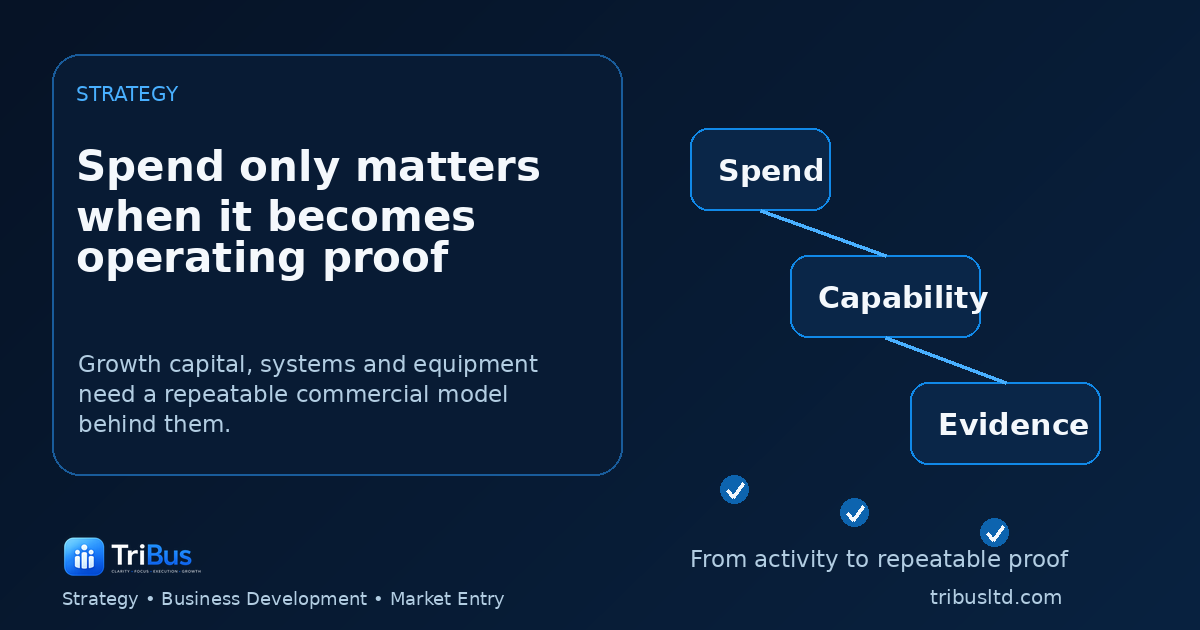
Spend is not the same as capability
It is easy to mistake investment activity for progress. A new system, a new machine, a new workflow tool, a new CRM, a new data platform or a new sales hire can all feel like forward motion.
Sometimes they are. Often they are only ingredients.
Capability appears when the spend changes how the business operates. Proof appears when that operating change becomes visible to customers, partners, funders or buyers. Until then, investment can remain internal activity with a hopeful business case attached.
This distinction matters because many technical SMEs are not short of ideas. They are short of conversion. They can see possible markets, productivity gains, export routes, service improvements and technology upgrades. The hard part is turning those options into repeatable commercial outcomes.
The buyer does not buy the investment
A customer rarely cares that a supplier has invested in a system. They care whether the supplier can deliver faster, reduce risk, improve quality, provide better evidence, support the implementation, or make the buying decision easier.
That means the commercial value of investment depends on translation.
If a business invests in production capacity, the commercial proof might be shorter lead times, greater resilience, clearer service levels or more reliable delivery promises. If it invests in digital systems, the proof might be better reporting, stronger account management, cleaner handovers or faster response times. If it invests in sales capability, the proof might be better qualification, stronger proposals and fewer weak-fit opportunities.
The spend itself is not the message. The operating proof is the message.
Cost caution makes proof more important
The current environment makes that discipline more important, not less. ONS business surveys through late summer 2026 continued to show businesses dealing with economic uncertainty, labour costs, energy concerns and supply-chain pressures. Make UK’s Q3 outlook suggested confidence had improved, but manufacturers remained cautious about hiring while costs still weighed on decisions.
That is exactly the environment in which investment needs a sharper commercial case.
When buyers are cautious, they look for confidence. When margins are under pressure, they look for evidence. When suppliers claim they are more capable, buyers want to see how that capability reduces risk for them.
A technical SME that has invested but cannot explain the customer impact has only half done the job.
Operating proof has to be designed
Operating proof does not usually appear by accident. It has to be designed into the way the business works.
That means asking practical questions before and after investment decisions:
- Which commercial problem is this investment meant to solve?
- Which customer segment, market or use case will feel the benefit first?
- What will be faster, clearer, safer, cheaper, more reliable or easier to buy?
- How will the sales team explain the change without overclaiming?
- What evidence will prove the change has worked?
- Does the delivery model support the promise now being made?
These questions are not theoretical. They decide whether investment becomes a growth lever or another internal project.
The operating model is the bridge
The bridge between spend and proof is the operating model.
That includes roles, handovers, data, decision rights, customer communication, delivery standards, pricing logic and management cadence. If those pieces do not change, the investment may sit on top of the old way of working rather than improving it.
This is why technology investments often disappoint. The tool may be capable, but the business still sells, hands over, delivers and reviews work in the same fragmented way. The result is more software, not more commercial proof.
The same applies to equipment, people and process investment. Capacity only matters if it is connected to the right market proposition. Sales resource only matters if it is pointed at the right customers. Data only matters if it improves a decision.
What technical SMEs should do next
The practical move is to audit recent and planned investment against commercial proof.
For each major spend decision, the business should be able to state the intended customer impact, the operating change required, the evidence that will prove progress, and the market message that follows from it. If those four elements are missing, the investment may still be useful, but it is not yet a commercial growth asset.
This does not require a heavy transformation programme. It requires clear thinking and disciplined follow-through.
The commercial point
Investment is positive only when it changes what the business can reliably do.
For technical SMEs, the advantage will not come from spending for its own sake. It will come from turning systems, equipment, people and process changes into operating proof that buyers can understand and trust.
In a cautious market, the strongest message is not “we have invested”. It is “this is what we can now prove”.
Sources reviewed included ONS business investment data for April to June 2026, ONS Business Insights and Conditions Survey releases from August and September 2026, UK Finance’s September 2026 Monthly Economic Review, and Make UK’s Manufacturing Outlook 2026 Q3.