


Growth leaders often ask for more leads when the real problem is not volume.
The problem is visibility.
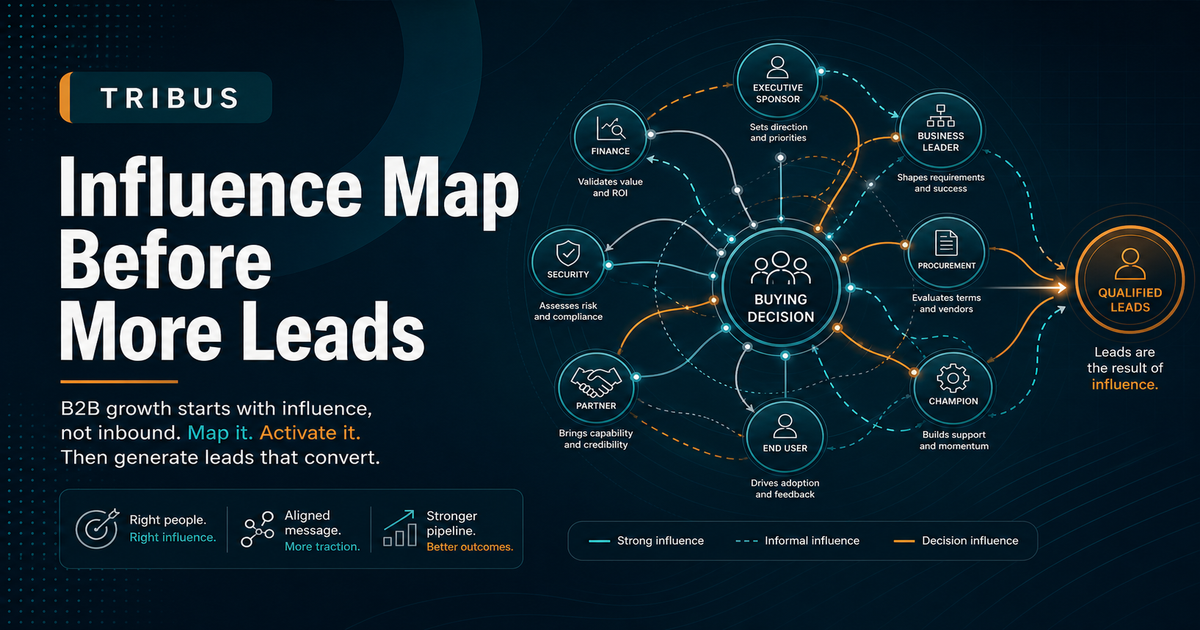
Too many teams still plan demand around a linear funnel: awareness, consideration, conversion. That model is tidy, but it does not describe how B2B buyers actually behave in 2026. Buyers move through fragmented journeys. They compare vendors through search, referrals, content, peer recommendations, analyst opinions, sales conversations and increasingly AI-assisted discovery. The route to revenue is no longer one path. It is a network.
BCG’s 2025 work on moving beyond the linear funnel makes the central point well: marketers need to plan around what actually drives influence, not just what is easiest to report. McKinsey’s 2026 B2B growth research reaches a similar conclusion from the sales side. Growth leaders are separating from the pack by combining hyperpersonalization, AI and stronger sales accountability into a more coherent operating system.
That is why the useful question is not, “How do we get more leads?”
It is, “What really changes a buyer’s confidence?”
Why the funnel is too small
The funnel is still useful as a shorthand. It helps teams talk about stages and conversion points. But it becomes a trap when it is treated as the business model itself.
Three things go wrong.
First, teams overvalue the last touchpoint. A buyer may close after a call with sales, but that does not mean the rest of the journey was irrelevant.
Second, teams confuse activity with impact. More impressions, more clicks and more gated content downloads can look productive while doing very little to shift serious buying intent.
Third, teams optimise channels in isolation. Search, email, events, content, customer proof and outbound outreach are not separate games. They are part of the same influence system.
If the business cannot see the whole system, it will keep making shallow decisions.
What an influence map shows
An influence map asks a better set of questions.
Which touchpoints build trust before a buyer ever speaks to sales?
Which messages reduce perceived risk?
Which proof points make the offer feel credible?
Where do buyers stall, and why?
What evidence matters to different people in the buying committee?
This is not just a marketing exercise. It is commercial diagnosis.
Once the business sees the map, it can stop treating every channel as equal and start investing in the things that actually move decisions:
- customer proof that feels relevant rather than generic;
- content that answers the uncomfortable questions buyers are already asking;
- sales language that matches the message on the website;
- sequencing that helps the buyer move from interest to confidence;
- measurement that includes assisted influence, not just final conversion.
Why this matters now
The economics of B2B growth are changing.
McKinsey’s May 2026 research shows a widening gap between growth leaders and laggards. The strongest performers are not just spending more. They are using AI, hyperpersonalization and better sales discipline to make the whole system work harder. That means the old habit of buying reach and hoping for conversion is getting more expensive.
At the same time, buyers are becoming more selective. They expect the business to understand their context, not just their company size. They expect evidence, not slogans. They expect the first serious conversation to feel informed.
That raises the bar for marketing and business development teams.
What TriBus would do with this
At TriBus, this is the point where strategy becomes practical.
We would start by mapping the real buying journey, not the ideal one. Then we would look for the moments where confidence rises or falls. That usually means aligning three things:
- the message;
- the proof;
- the commercial follow-through.
If one of those is weak, the system leaks.
The business may still get leads, but they will be less qualified, slower to convert and harder to defend internally. If the map is stronger, the business can spend with more confidence because it knows which signals actually matter.
That also makes the work easier to improve. Instead of asking whether marketing “worked”, leadership can ask where influence was built, where it was lost, and what to do next.
A practical takeaway
If your current reporting still treats every buyer as if they came from one clean path, the model is too simple.
The better question is not which channel closed the deal.
It is which combination of signals made the deal possible.
That is the kind of marketing system that helps a growing business spend with more discipline and less wishful thinking.
Source references
- Boston Consulting Group, It’s Time for Marketers to Move Beyond a Linear Funnel – https://www.bcg.com/publications/2025/move-beyond-the-linear-funnel
- McKinsey, The surprising economics of B2B growth: The new survival threshold and what it takes to thrive – https://www.mckinsey.com/capabilities/growth-marketing-and-sales/our-insights/the-surprising-economics-of-b2b-growth-the-new-survival-threshold-and-what-it-takes-to-thrive
- McKinsey, Growth amid uncertainty: Jump-starting B2B sales performance – https://www.mckinsey.com/capabilities/growth-marketing-and-sales/our-insights/growth-amid-uncertainty-jump-starting-b2b-sales-performance