


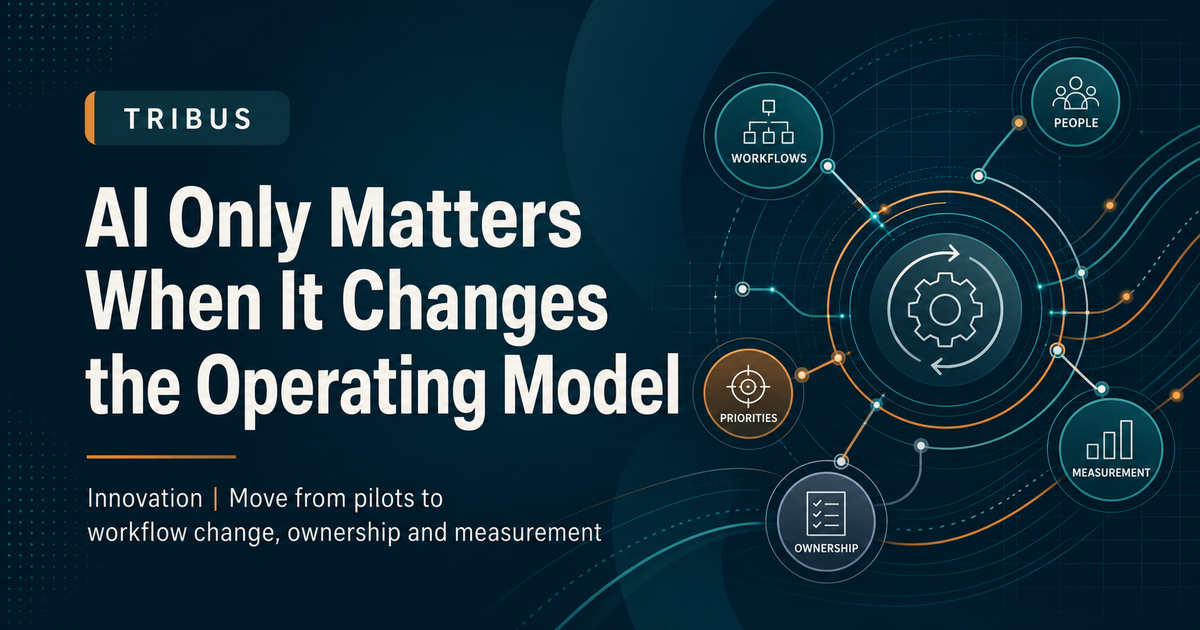
AI is still being sold in too many organisations as if the pilot itself were the prize.
It is not.
Launching an experiment is easy compared with changing how the business actually works. That second step is where most AI programmes stall. The tool is interesting. The demo is impressive. The workflow is unchanged.
That is why experimentation is not the same thing as commercial value.
Why pilots stall
The pattern is familiar.
A team picks a use case, gets a promising result, shares a deck and then runs into the real world:
- nobody owns the process end to end;
- the data is not clean enough;
- humans do not know when to trust the output;
- the result is useful but not measured;
- the pilot never becomes part of daily work.
At that point, the business has not transformed anything. It has only added another layer of activity.
That matters because AI can make weak processes move faster. If the workflow is broken, AI does not magically fix it. It often just reveals the break more quickly.
What operating model change looks like
Operationalisation is the difference between a tool and a capability.
It means the organisation decides:
- which workflows are worth changing;
- what humans should review and when;
- what data quality is required;
- who owns the decision;
- how value will be measured;
- when to scale, pause or redesign.
That is less exciting than a launch announcement, but it is where the business gets paid.
The current wave of AI thinking is pointing in the same direction. The strongest organisations are not just asking what the model can do. They are asking how to redesign the work around it so the output is actually absorbed into the business.
The commercial test
TriBus would push every AI idea through a simple commercial test.
Does this improve one of the following?
- revenue quality;
- cost-to-serve;
- decision speed and accuracy;
- customer experience;
- delivery capacity.
If the answer is no, the use case is probably a distraction.
That is important because AI can be seductive. It makes inefficient teams feel productive. It produces content, summaries, analysis and draft decisions at a pace that can look like progress. But if the business does not redesign the surrounding process, it is only creating clever output, not durable value.
What good teams do differently
The teams that actually benefit from AI do not treat it like a side project.
They build structure around it:
- clear decision rights;
- a defined workflow;
- explicit human checks;
- data standards;
- KPI ownership;
- a path from pilot to adoption.
That is the practical side of innovation.
It is also where many leadership teams need support. The technical question is often less important than the organisational one. What needs to change in the operating model? Who has to sign off? What gets measured? What gets removed?
If those questions are left vague, the business gets stuck in the comfortable middle ground of trying things without committing to change.
Why this fits the TriBus view
TriBus is interested in innovation when it strengthens the commercial model.
That means AI is not the headline. The business outcome is the headline. Better process. Faster execution. Sharper judgement. Stronger use of people. More dependable output.
That links back to the TriBus pillars:
- commercial clarity;
- growth structure;
- founder and leadership support;
- practical execution.
Innovation should make a business stronger, not just busier.
A practical takeaway
If your AI programme still lives in pilots, workshops and slides, it probably is not commercial yet.
The next step is to operationalise it:
- choose one high-value workflow;
- define the human and machine roles;
- set the data and quality bar;
- measure the outcome;
- build the repeatable operating model around it.
That is where AI stops being interesting and starts becoming useful.
Source references
- McKinsey, The state of AI in 2025: Agents, innovation, and transformation – https://www.mckinsey.com/capabilities/quantumblack/our-insights/the-state-of-ai
- McKinsey, Building the foundations for agentic AI at scale – https://www.mckinsey.com/capabilities/mckinsey-technology/our-insights/building-the-foundations-for-agentic-ai-at-scale
- McKinsey, The agentic organization: Contours of the next paradigm for the AI era – https://www.mckinsey.com/capabilities/people-and-organizational-performance/our-insights/the-agentic-organization-contours-of-the-next-paradigm-for-the-ai-era