


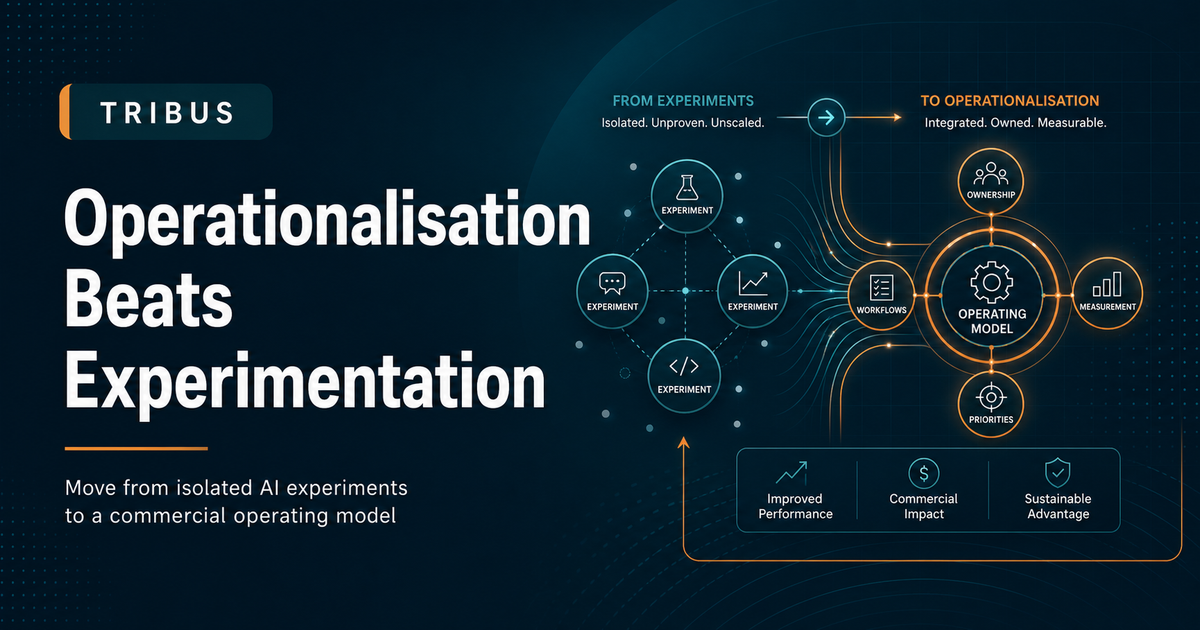
The biggest mistake in the current AI conversation is treating experimentation as the finish line.
It is not.
Plenty of businesses now have pilots, proofs of concept and internal demo days. That is useful, but it is not commercial transformation. The hard part starts after the first enthusiasm fades: turning AI into a reliable part of the operating model.
McKinsey’s 2025 State of AI survey makes this plain. AI use is growing, including agentic AI, but the move from pilots to scaled impact is still unfinished in most organisations. The pattern is familiar: teams can launch experiments faster than they can redesign the work around them.
That is the real commercialization gap.
Why pilots stall
Many AI initiatives fail for the same reason.
They are attached to a use case, not a workflow.
A team buys a tool, runs a trial, gets a few promising outputs and then hits friction:
- nobody owns the process end to end;
- the data is inconsistent;
- humans do not know when to trust the output;
- the result is interesting but not measurable;
- the pilot never gets embedded into day-to-day work.
That is why many AI programmes feel busy without becoming valuable.
The issue is not model quality alone. It is operating discipline.
What operationalisation actually means
Operationalisation means AI is no longer a side experiment. It is part of how the business works.
That requires more than a prompt library or a sandbox trial. It means the organisation decides:
- which workflows are worth agentifying;
- what human review is required and when;
- what data quality standards apply;
- who owns the process;
- how value will be measured;
- when to scale, pause or redesign.
McKinsey’s April 2026 work on building the foundations for agentic AI at scale points to the same conclusion. Agentic AI only scales on strong data, modernised architectures and evolved operating models. In other words, the technology matters, but the system around it matters more.
If the surrounding process is weak, the AI will simply accelerate the weakness.
The commercial test
For leadership teams, the right question is not, “Can this model do something clever?”
It is, “Can this create durable commercial value?”
That means asking whether the AI use case will improve one of three things:
- revenue quality;
- cost-to-serve;
- decision speed and accuracy.
If it does not move one of those levers, the initiative is probably a distraction.
This is especially relevant for commercial teams. AI can help with research, segmentation, content generation, proposal drafting and internal analysis. But if those outputs are not connected to a real commercial process, they remain nice-to-have.
Commercial value appears when AI shortens the path from insight to action.
What the high performers do differently
McKinsey’s 2025 survey also shows that high performers are more likely to have senior leadership ownership, defined validation rules and practices that support scaling. That matters because scaling is mostly a management problem.
The best organisations do not ask teams to improvise their way into transformation. They build a structure around it.
That usually includes:
- clear decision rights;
- a defined workflow;
- explicit human checks;
- data standards;
- KPI ownership;
- a route from pilot to adoption.
This is where many businesses need to be more honest. They do not have an AI strategy problem. They have an execution design problem.
Why TriBus cares about this
TriBus sits at the point where strategy, commercialisation and operational reality meet.
That matters because the businesses we care about are not just trying to look innovative. They are trying to use innovation to support growth, margin and better decisions.
From that perspective, AI is not the prize. The prize is a better business:
- clearer process;
- faster execution;
- stronger judgement;
- better use of people;
- more dependable commercial output.
If AI helps with that, good. If it only creates noise, it is a cost.
A practical takeaway
If your AI programme still lives in pilots, workshops and slides, it is probably not yet commercial.
The next step is to operationalise it:
- pick one high-value workflow;
- define the human and machine roles;
- set the data and quality bar;
- measure the outcome;
- build the repeatable operating model around it.
That is where AI stops being interesting and starts becoming useful.
Source references
- McKinsey, The state of AI in 2025: Agents, innovation, and transformation – https://www.mckinsey.com/capabilities/quantumblack/our-insights/the-state-of-ai
- McKinsey, Building the foundations for agentic AI at scale – https://www.mckinsey.com/capabilities/mckinsey-technology/our-insights/building-the-foundations-for-agentic-ai-at-scale
- McKinsey, The agentic organization: Contours of the next paradigm for the AI era – https://www.mckinsey.com/capabilities/people-and-organizational-performance/our-insights/the-agentic-organization-contours-of-the-next-paradigm-for-the-ai-era