


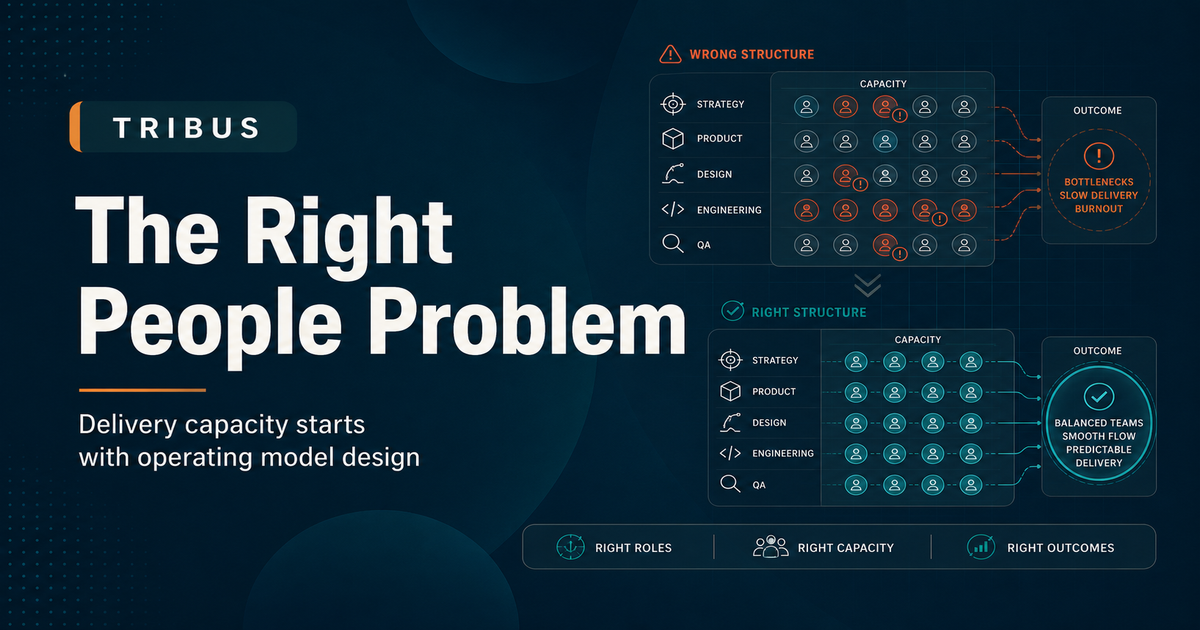
When delivery slips, the first reaction is often to say the team needs more hands.
Sometimes that is true. But very often the real issue is not just headcount. It is design. The business has too much work sitting with too few people, too many handoffs, unclear ownership or an operating model that has not kept pace with growth.
Deloitte’s recent human capital thinking reflects this reality. The organisations that adapt best are not simply adding people. They are redesigning work, skills, roles and leadership rhythms so the business can move faster without burning people out.
That matters because delivery capacity is not just an HR issue. It affects customer experience, margin, retention, staff morale and the speed at which the business can grow.
The business problem
Most growing companies reach a point where the structure that worked at one size starts to strain.
What used to be direct and personal becomes inconsistent. The founder can no longer be in every conversation. The same people who were great at winning work now spend too much time putting out fires. Important tasks land on people who are already overloaded.
The symptoms are familiar:
- deadlines slip
- the team works harder but progress feels slower
- customers start to notice inconsistency
- internal communication becomes reactive
- good people begin to feel stretched or frustrated
At that point, the issue is no longer simply “busy”.
It is a support and delivery design problem.
The cost of ignoring it
If a business does not address delivery capacity early, the cost compounds quickly.
The most obvious cost is missed delivery. Projects run late, service levels wobble and quality becomes harder to control.
The second cost is margin pressure. Teams often respond by throwing more time at the problem, which hides the issue for a while but makes profitability weaker.
The third cost is people risk. Burnout, disengagement and turnover are common when capacity is treated as an endless stretch rather than a finite resource.
And the fourth cost is strategic. Leadership can no longer trust the plan if the team cannot reliably deliver what has been sold.
That is why support matters. It is not a back-office function. It is part of growth execution.
What better support looks like
A stronger delivery model does not always mean a bigger team.
It usually means a clearer one.
-
- Map the work honestly.
What actually gets done each week, and who does it? Leaders often discover that hidden admin, duplicate reviews and informal support consume far more time than expected.
-
- Clarify ownership.
Every recurring task should have a clear owner and a clear standard. Ambiguity is one of the fastest ways to create drag.
-
- Separate urgent from important.
Many teams live in reactive mode because nothing is prioritised properly. A simple prioritisation rhythm can do more than another layer of meetings.
-
- Design for skills, not just roles.
Some work needs specialist expertise. Some work can be done by a broader team. A skills view often reveals better ways to use capacity.
-
- Build a realistic escalation path.
If the same issue keeps landing with senior people, the process has not been designed well enough.
-
- Measure strain before it becomes churn.
Managers should know where people are overloaded before performance drops or people leave.
Where TriBus fits
Support is one of the TriBus pillars because we know growth is rarely limited by strategy alone.
The right advice can improve execution quickly, but only if the business has enough structure around it. That can mean embedded support, delivery support, process clarity or a better operating rhythm.
In practical terms, we help leaders make the team more effective without turning every problem into a hiring decision.
That is often where the real value sits: not just more people, but the right mix of people, process and accountability.
A useful test for leadership teams
If one person left tomorrow, would the business know exactly what work would break?
If the answer is “not really”, the capacity model is probably too fragile.
That does not mean the business is broken. It means the operating model needs attention before growth makes the strain worse.
Support done well gives the rest of the business room to perform.
## Source references
* Deloitte, *2025 Global Human Capital Trends* — https://www.deloitte.com/us/en/insights/topics/talent/human-capital-trends.html