


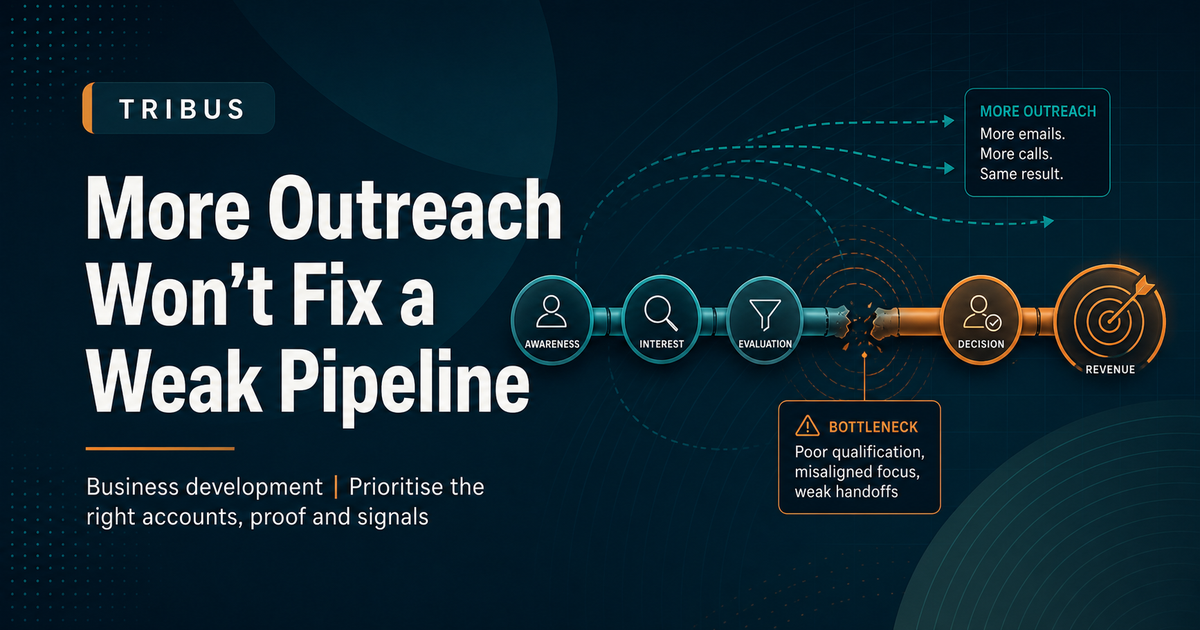
Too many growth teams still treat pipeline problems as if they were volume problems.
They are not always volume problems.
If the wrong accounts are being chased, the message is too generic, the handoff from marketing to sales is sloppy, or the buyer has not built enough confidence to move, the answer is not simply to send more emails and hope harder.
The better answer is prioritisation.
That matters because modern B2B demand is not moving through a neat sequence anymore. Buyers are comparing vendors across search, referrals, peer recommendations, sales conversations, content, and increasingly AI-assisted discovery. The journey is fragmented, and the signals that matter are spread across the whole path to purchase.
The real problem is not activity
Most weak pipelines look busy.
There are sequences running, calls being made, campaigns being launched and dashboards full of movement. But activity is not the same thing as momentum.
The common failure modes are easy to spot:
- accounts are selected because they are available, not because they are a fit;
- messaging is written for the market in general, not for the buyer in front of you;
- marketing and sales measure different things, so nobody agrees what good looks like;
- the team celebrates first meetings, but not qualified progress;
- the same weak list gets worked again and again with no learning loop.
At that point, more outreach just creates more noise.
It does not create better odds.
Why prioritisation changes the game
Good prioritisation narrows the field before anyone starts pressing for response.
That means choosing accounts, segments and buying situations where the business has a genuine reason to win. It also means being honest about where the offer is strongest and where it is weak.
TriBus would usually start with three questions:
- Which accounts are genuinely worth the effort?
- Which signals tell us the buyer is ready for a serious conversation?
- What proof do we need to remove friction and build confidence?
If those questions are not clear, the pipeline will keep leaking.
This is where a lot of growth teams get stuck in a false choice. They think the options are either broad top-of-funnel activity or expensive account-based precision. In practice, the right answer is a disciplined blend: enough reach to create opportunity, and enough focus to stop wasting time on accounts that were never going to convert.
What better pipeline design looks like
Better pipeline design is less glamorous than a campaign launch and more useful.
It usually includes:
- a tighter ideal customer profile based on real wins, not wishful thinking;
- a clear view of the buying committee and the proof each person needs;
- stage definitions that reflect real commercial progress, not internal theatre;
- shared definitions between sales and marketing;
- a feedback loop that shows which messages, channels and offers actually move deals.
That is not just operational tidiness.
It is commercial clarity.
When the team knows which signals matter, it stops overvaluing vanity metrics. It starts asking better questions about fit, timing, friction and confidence.
That is where margin improves too. A stronger pipeline is usually not just bigger. It is cleaner. Fewer wasted hours. Better qualification. Better forecast quality. Better use of senior time.
Why this fits the TriBus view
TriBus sits on the commercial side of growth.
That means we are interested in the stuff that changes outcomes: sharper positioning, stronger routes to market and more disciplined execution. A weak pipeline is rarely solved by shouting louder. It is solved by understanding where confidence is being lost and fixing the system around it.
That links directly to the TriBus pillars:
- commercial clarity;
- growth structure;
- market access;
- founder and leadership support;
- practical execution.
The point is not to create more motion. The point is to create better motion.
A practical takeaway
If the pipeline is weak, resist the instinct to simply increase output.
Start here instead:
- narrow the account list;
- define the buying signals that really matter;
- align marketing and sales on the same stage logic;
- add proof that reduces buyer risk;
- review whether the current activity is actually improving win quality.
If the answer is no, more outreach is just more expense.
Better prioritisation is cheaper, calmer and far more likely to create momentum that lasts.
Source references
- Boston Consulting Group, It’s Time for Marketers to Move Beyond a Linear Funnel – https://www.bcg.com/publications/2025/move-beyond-the-linear-funnel
- McKinsey, Growth amid uncertainty: Jump-starting B2B sales performance – https://www.mckinsey.com/capabilities/growth-marketing-and-sales/our-insights/growth-amid-uncertainty-jump-starting-b2b-sales-performance
- McKinsey, The surprising economics of B2B growth: The new survival threshold and what it takes to thrive – https://www.mckinsey.com/capabilities/growth-marketing-and-sales/our-insights/the-surprising-economics-of-b2b-growth-the-new-survival-threshold-and-what-it-takes-to-thrive