


For years, marketing teams have been trained to think in funnels.
Awareness. Consideration. Conversion. Done.
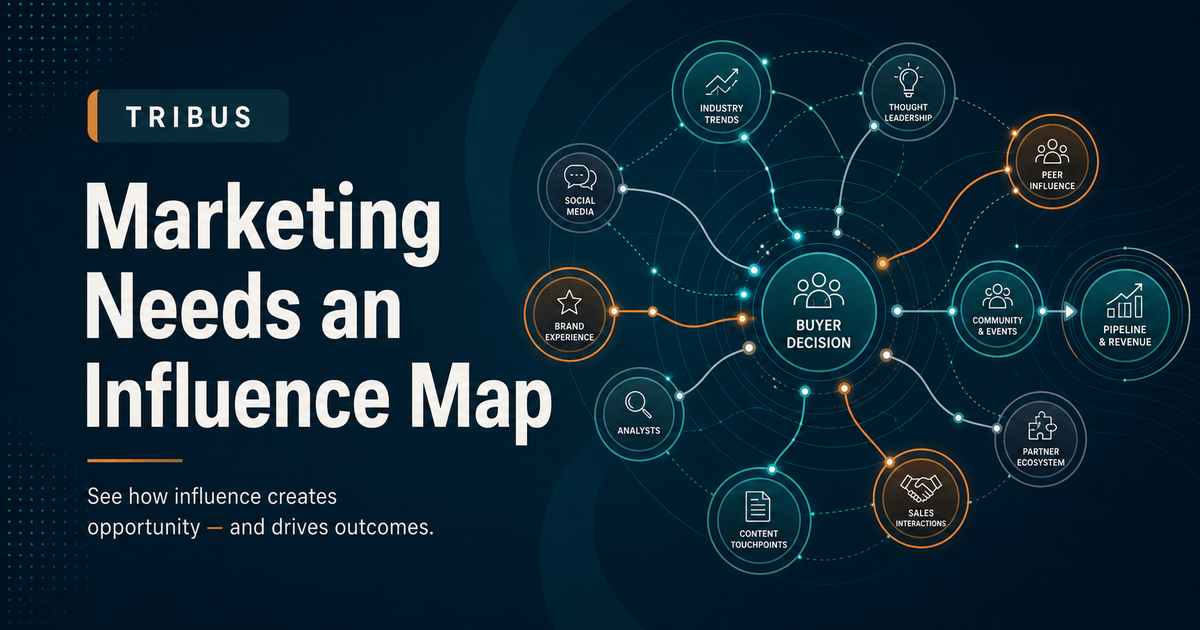
That model is useful, but it is no longer enough on its own. Buyers do not move through a neat line of touchpoints. They move through a network of signals: search, referrals, social proof, content, reviews, email, events, sales conversations, partner recommendations and operational trust.
BCG’s recent work on moving beyond the linear funnel makes the point clearly: if marketing only measures a straight path to conversion, it misses the real shape of influence. McKinsey’s latest marketing and sales insights point in the same direction. Winning organisations are using data, content, personalisation and orchestration to shape the buying journey more intelligently.
The business problem
Many leadership teams still ask marketing to prove its value using overly simple metrics.
That tends to create three problems.
First, activity gets mistaken for impact. A campaign can produce clicks, impressions and engagement without shifting buyer confidence.
Second, the business over-credits the last touchpoint. If a lead converts after a sales call, that does not mean the entire journey before it had no effect.
Third, teams argue over channels instead of working out how the full system performs. Search, social, events, email and sales are not rivals. They are part of the same influence chain.
The result is often frustration: marketing feels under-appreciated, sales feels under-supported and leadership is left with incomplete evidence.
The cost of ignoring the issue
If the business keeps thinking in funnel-only terms, it risks making the wrong investment decisions.
It may keep funding channels that look efficient in isolation but do little to build trust. It may cut brand activity too early. It may overvalue short-term leads and undervalue the content, credibility and proof that make future conversion easier.
And because B2B buyers are usually cautious, this matters. In complex sales, trust accumulates over time. If the business does not understand where that trust is being built, it will struggle to scale demand in a predictable way.
What a better model looks like
A more useful approach is to treat marketing as an influence map.
That means asking:
- Which touchpoints shape confidence before a buyer ever speaks to sales?
- Which messages reduce perceived risk?
- Which channels create awareness but not enough authority?
- Which proof points move a buyer from interest to action?
- What role do existing customers play in shaping trust?
Once those questions are answered, the business can design a much better marketing system.
-
- Define the actual decision journey.
Do not assume buyers follow your preferred path. Map the real path they take, including the informal signals and external sources they rely on.
-
- Balance brand and demand.
Performance marketing is important, but it works better when the market already knows who you are and why you matter.
-
- Use content to reduce buyer risk.
Good content is not just for traffic. It should answer the questions a cautious buyer is already asking.
-
- Measure influence, not just conversion.
Look at assisted conversion, engagement quality, sales feedback and channel interaction, not just the final click.
-
- Connect marketing to sales language.
If the website, campaigns and sales conversations use different wording, the business will sound less credible than it needs to.
-
- Use AI to accelerate, not replace, judgment.
AI can help with testing, segmentation and draft production. It cannot replace commercial clarity.
Why this matters for TriBus
Marketing strategy only works when it is commercially grounded.
At TriBus, we look at marketing as part of a bigger growth system. That means the message, offer, evidence and commercial process all need to line up. If they do, marketing becomes easier to defend, easier to improve and easier to connect to business outcomes.
This is also why marketing sits close to business development and strategy in the TriBus model. The point is not to create more content for its own sake. The point is to move the market’s perception of the business in a direction that helps growth happen.
A practical takeaway
If your reporting still treats every buyer like they came from one single channel, the model is probably too simple.
The real question is not “Which channel closed the deal?”
It is “Which combination of signals made the deal possible?”
That is the kind of marketing view that helps a growing business spend with more confidence.
## Source references
* BCG, *Move Beyond the Linear Funnel* — https://www.bcg.com/publications/2025/move-beyond-the-linear-funnel
* McKinsey, *Growth marketing and sales insights* — https://www.mckinsey.com/capabilities/growth-marketing-and-sales/our-insights