


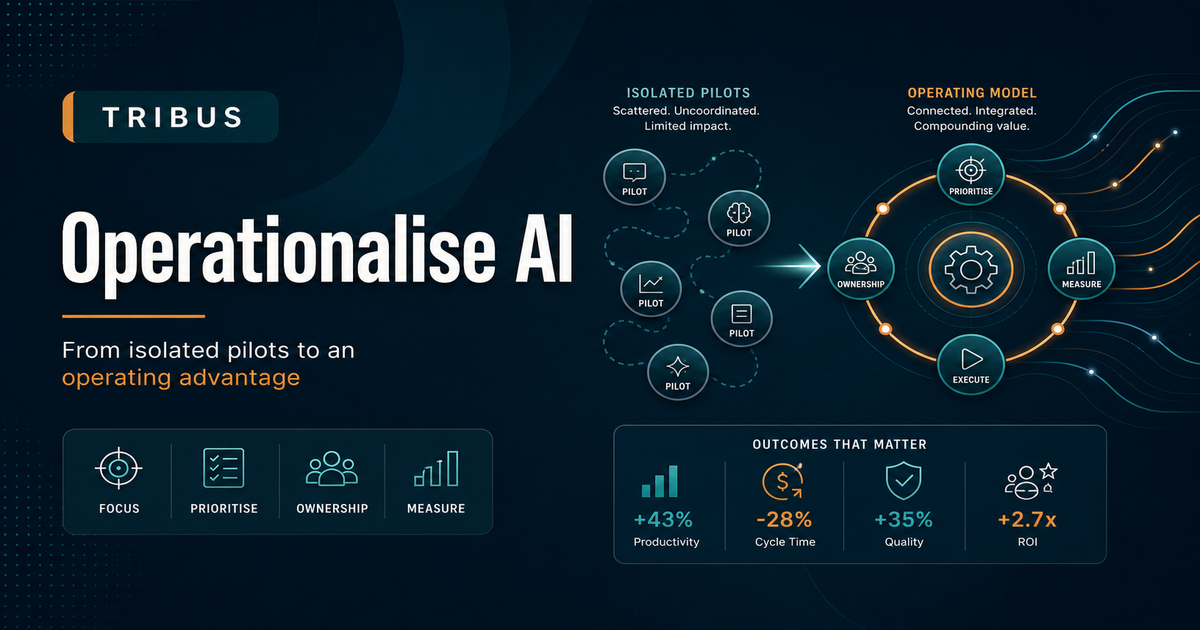
There is no shortage of AI enthusiasm in business right now.
Most leadership teams have seen the demos. Many have approved pilots. Some have even launched internal tools. But the gap between experimenting with AI and using it in a way that improves the business is still wide.
That gap matters because innovation is only valuable when it changes behaviour, workflow or decision quality. If AI is bolted on to old processes, it becomes a demo. If it is designed into the way teams work, it becomes a lever.
Deloitte’s 2026 State of AI in the Enterprise report points to this tension clearly. Access to AI is increasing, but access on its own is not transformation. Real value still depends on governance, workflow redesign, management discipline and a clear connection to business outcomes.
The business problem
Too many organisations still treat innovation as a side project.
That creates a familiar pattern:
- a pilot is launched with energy and optimism
- a small team gets access to a tool
- a few good use cases are identified
- progress slows once the pilot meets operational reality
- the business cannot prove impact clearly enough to scale
The problem is not usually the technology. It is the operating model around the technology.
Innovation work fails when it is framed as “try this tool” rather than “change this workflow”.
The commercial consequence of ignoring it
When AI remains trapped in pilot mode, the business loses twice.
First, it loses speed. Teams keep doing manual work that could be simplified or accelerated, but no one has redesigned the process.
Second, it loses credibility. Leaders begin to associate innovation with experimentation rather than measurable improvement. That makes it harder to secure buy-in for the next round of change.
There is also a quieter risk: shadow AI. If the business does not create a sensible route for adoption, employees will find their own tools and methods anyway. That can create inconsistency, data risk and avoidable governance problems.
What operationalised innovation looks like
The answer is not to run more pilots for the sake of it. It is to choose the right use cases and embed them properly.
-
- Start with a workflow pain point.
Look for repetitive, slow or error-prone work. AI is most useful when it removes friction from a process people already understand.
-
- Tie every use case to a business metric.
That metric might be cycle time, conversion rate, response time, margin, forecast accuracy or customer satisfaction. If the metric is unclear, the project will be harder to defend.
-
- Design governance at the same time as the tool.
Who can use it? What data can it touch? What needs review? What is not allowed? Clear rules increase adoption because they reduce uncertainty.
-
- Train managers, not just users.
People adopt new tools more quickly when their managers can explain why the change matters and how success will be measured.
-
- Redesign the process, not just the interface.
If the old workflow remains intact, AI will sit on top of inefficiency instead of removing it. The best gains usually come from simplifying the sequence of work.
-
- Scale only after the pilot proves behaviour change.
A successful demo is not the same as a successful rollout. The real question is whether the organisation uses the new capability differently a month later.
Why this matters beyond technology teams
Innovation is often thought of as the domain of product, data or IT teams.
In reality, commercial businesses need innovation across the whole operating model:
- strategy teams need better decision support
- sales teams need stronger prioritisation and follow-up
- marketing teams need faster insight and sharper content workflows
- delivery teams need reduced admin and better visibility
- leadership teams need cleaner evidence for decisions
That is why innovation is not separate from strategy or support. It is part of how the business stays competitive.
Where TriBus fits
TriBus is interested in innovation only when it improves commercial performance.
That means we are less interested in shiny tech talk and more interested in practical value: where can the business work faster, decide better, serve customers more effectively or unlock capacity?
That approach also keeps innovation grounded. Businesses do not need every new tool. They need the right tool in the right process, backed by a commercial case that makes sense.
If innovation is going to matter, it must leave fingerprints in the real business:
- cleaner workflows
- faster decisions
- better use of people
- stronger commercial execution
- less wasted effort
A practical test
If AI disappeared tomorrow, would the business notice?
If the answer is no, the innovation is probably not embedded deeply enough.
The goal is not to use AI everywhere. The goal is to use it where it changes the economics or quality of the work.
That is where the opportunity really sits.
## Source references
* Deloitte, *2026 State of AI in the Enterprise* — https://www.deloitte.com/us/en/what-we-do/capabilities/applied-artificial-intelligence/content/state-of-ai-in-the-enterprise.html