


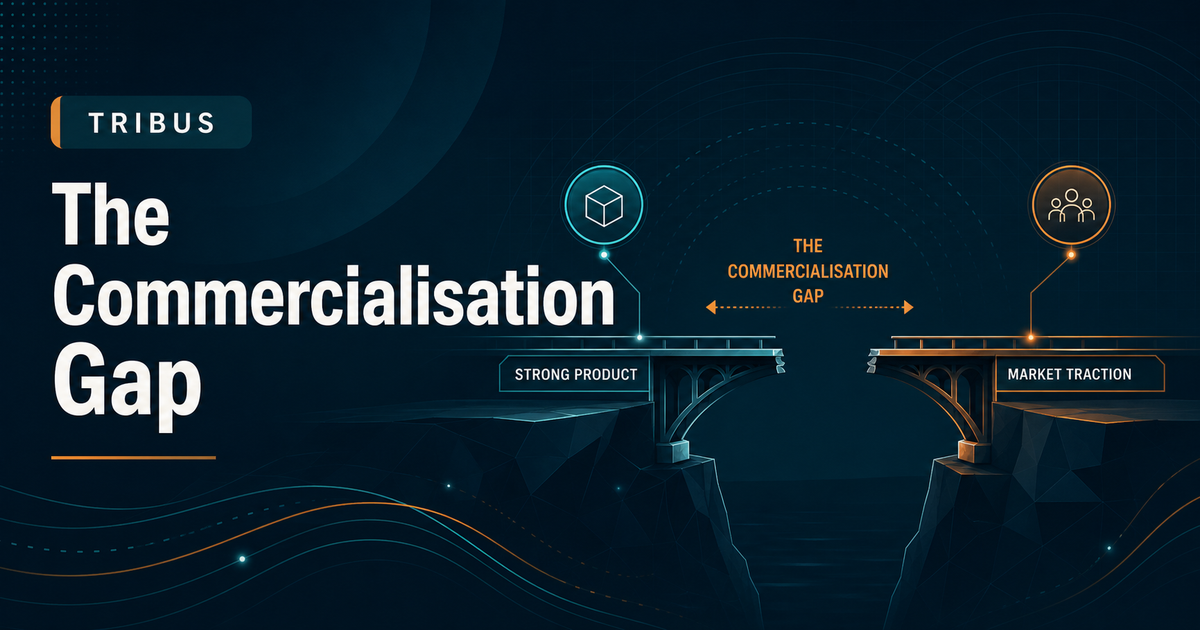
It is common to hear teams say, “The product is ready, now we just need to launch it.”
That sentence is usually a warning sign.
Product readiness is not the same thing as market readiness. A product can be technically sound, well engineered and genuinely useful, while still failing commercially because the business has not thought through positioning, pricing, route to market, onboarding, sales enablement or the practical reality of adoption.
McKinsey’s work on how companies develop and commercialise products makes the point well: companies that redesign the development and launch process can compress timelines and reduce avoidable friction. In some cases, the report notes, digital tools and shelf-testing approaches cut development timelines significantly. The lesson is not just about speed. It is about building commercial evidence earlier, before resources are locked into a launch that has not been tested properly.
The business problem
Commercialisation fails when teams confuse internal confidence with external demand.
Inside the business, the product may feel complete. The team knows the feature set, the engineering has signed off, and leadership wants to move quickly. But customers do not buy internal confidence. They buy a clear reason to change, a price that makes sense, and an offer that feels safe enough to adopt.
That means the real work of commercialisation includes questions that are often left too late:
- Who is the first customer segment, and why them?
- What specific problem is solved, in language buyers actually use?
- How does the offer land in the market compared with alternatives?
- What proof will reduce buyer risk?
- Can the delivery model scale without damaging margins?
If those answers are vague, the launch will absorb time and budget without generating traction.
The cost of getting it wrong
The cost of poor commercialisation is bigger than a weak first quarter.
There is the obvious cost of wasted launch spend. But there is also a strategic cost that is easy to miss.
When a launch underperforms, leaders often react by pushing sales harder or spending more on promotion. That can create a false sense of action while the underlying commercial model remains broken.
Poor commercialisation also slows learning. If the early proposition is weak, the business cannot clearly see whether the problem is product fit, pricing, message, audience or channel. The result is muddled feedback and longer recovery time.
And in some businesses, especially those moving from founder-led selling into a wider market, a weak launch can damage confidence internally. Teams begin to treat the market as more difficult than it really is, when the real issue was a poorly structured go-to-market plan.
What strong commercialisation looks like
Good commercialisation starts before launch, not after it.
The best teams treat it as a structured progression from insight to proof to scale.
-
- Start with a market problem, not a product feature.
If the value proposition is built around what the product does rather than what the customer needs, messaging will be harder to sell and harder to scale.
-
- Test the offer earlier than feels comfortable.
Early market tests are not a sign of weakness. They are how businesses avoid expensive assumptions. Lightweight pilots, customer interviews, sample offers and limited rollouts all reduce risk.
-
- Price for adoption and margin, not hope.
Pricing is part of the product. If it is set without a commercial model in mind, the business may win attention but lose profitability.
-
- Build the launch plan alongside the product plan.
Sales collateral, customer onboarding, service design, FAQ handling and internal training all matter. A good launch is usually the result of a lot of unglamorous preparation.
-
- Make the delivery model part of the launch.
A brilliant offer that cannot be delivered reliably is not a commercial asset. It is a future support problem.
-
- Use evidence, not enthusiasm, to decide the next step.
Early signals should shape whether the business expands, refines, repositions or pauses.
Why this matters for TriBus
Commercialisation sits at the point where strategy becomes reality.
At TriBus, we often see businesses with strong ideas, capable teams and real market potential. What they do not always have is a commercial pathway that joins the product, the buyer and the delivery model cleanly enough to scale.
That is where our work helps: sharpening the offer, defining the market entry approach, creating commercial clarity and making sure the business is not just launching something, but launching it in a way that can actually hold up in the market.
This also links directly to strategy and business development. If a product cannot be explained simply, priced sensibly and delivered consistently, growth will remain harder than it needs to be.
A practical rule of thumb
If the launch plan can fit on one page, it is probably too simple.
Not because it needs to be overcomplicated, but because good commercialisation usually has to cover the decision chain from insight to adoption. If that chain is not visible, the market will expose the gap quickly.
The better question is not “Is the product ready?”
It is “Have we made it easy for the right market to understand, trust and buy this?”
## Source references
* McKinsey, *Top trends disrupting how companies develop and commercialize products* — https://www.mckinsey.com/capabilities/operations/our-insights/top-trends-disrupting-how-companies-develop-and-commercialize-products