


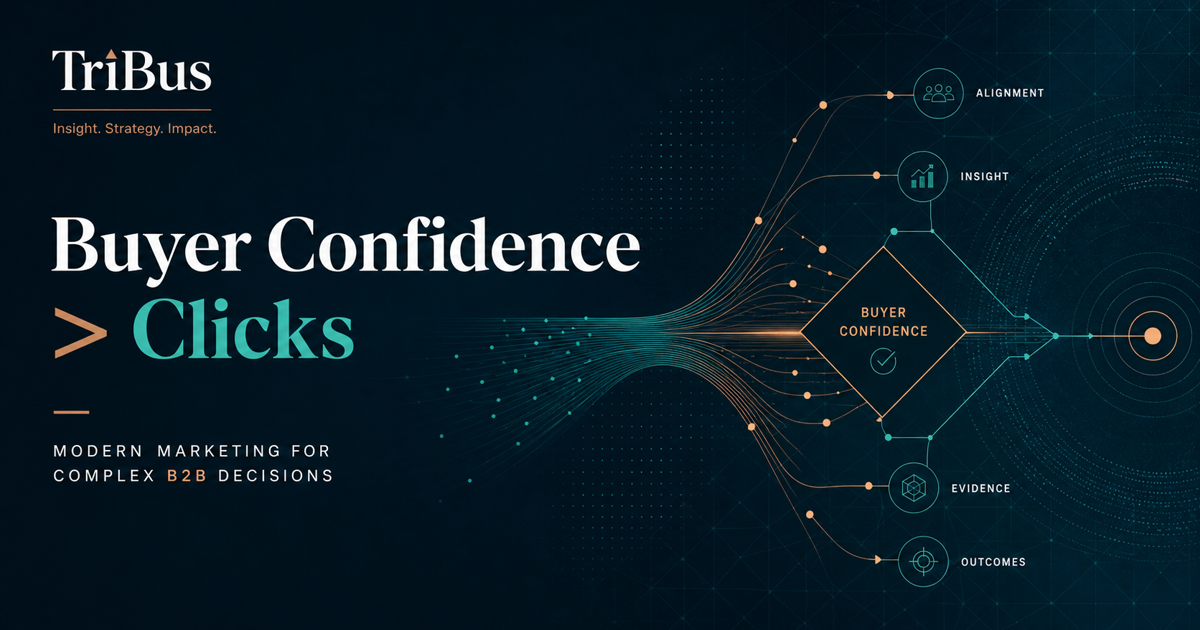
Too many marketing teams still measure their work by how much they ship.
That is understandable. Content is easy to count. Posts, PDFs, emails and campaigns all produce neat dashboards. But the business does not get paid for output. It gets paid when a buyer has enough confidence to move.
That is the real shift in B2B demand right now. Buyers are not following one clean funnel. They are moving through a messy mix of search, peer recommendations, sales conversations, customer proof, events, social content and AI-assisted discovery. The journey is fragmented, and the signals that matter are scattered across it.
BCG’s 2025 work on moving beyond the linear funnel is useful here because it makes a simple point: the old model is too neat for the way people actually buy. McKinsey’s B2B growth research says something similar from a performance angle. The winners are not just spending more. They are using better commercial discipline, stronger personalisation and more coherent execution to turn attention into revenue.
So the useful question is not, “How do we create more content?”
It is, “What actually builds confidence?”
Why more content stops working
Content still matters. But a lot of content is written for the marketing calendar rather than the buyer’s decision.
That creates a familiar problem:
- the team publishes because it needs to publish;
- the message sounds broadly correct but not especially useful;
- the assets do not line up with what sales says in live conversations;
- the buyer gets lots of information and not much clarity;
- the organisation mistakes activity for influence.
At that point, more content just creates more surface area.
It does not necessarily create more trust.
And trust is what moves a serious commercial decision forward.
What confidence actually looks like
Buyer confidence is not a vague brand feeling. It is practical.
It shows up when a prospect can answer a few basic questions:
- Do these people understand my problem?
- Have they solved something like this before?
- Can they explain the trade-offs honestly?
- Is the risk worth taking now?
- Will this still make sense once I involve the rest of the buying group?
If your content does not help answer those questions, it is not doing enough.
That is why the strongest marketing systems do not obsess over volume. They build proof and sequencing. They know which asset introduces the idea, which one deepens credibility, which one answers objections and which one supports the sales conversation.
That is a far more useful model than simply asking for another batch of posts.
The TriBus view
TriBus would treat this as a commercial clarity problem, not a content problem.
The point is to map where confidence is won and lost, then build the marketing around that map.
That usually means:
- identifying the messages that actually reduce risk;
- using proof that feels close to the buyer’s situation;
- aligning web copy, sales talk tracks and follow-up material;
- focusing on the few moments in the journey that really change the odds;
- measuring assisted influence, not just last-click conversions.
That is less glamorous than a content treadmill. It is also more useful.
The best marketing teams are not trying to be louder than everyone else. They are trying to be clearer, more relevant and harder to ignore.
Why this matters now
The pressure on marketing is rising because buying committees are more selective and more self-directed than they used to be. Buyers arrive with more information, more comparisons and more scepticism.
At the same time, AI is making it easier for them to summarise, compare and filter what they see. That means generic content gets stripped out faster. If the substance is weak, the buyer notices quickly.
This is good news for businesses that have something real to say.
It rewards:
- sharper positioning;
- better proof;
- more honest differentiation;
- tighter alignment between marketing and sales;
- a clearer view of where the market actually responds.
It punishes noise.
A practical takeaway
If your current plan still starts with “we need more content,” pause.
Ask instead:
- what buyer question are we trying to answer?
- what proof would make this feel credible?
- where in the buying journey does this asset belong?
- what happens next if the buyer engages?
If you cannot answer those questions, the content will probably not move the commercial needle.
Buyer confidence beats more content because confidence creates movement, and movement creates revenue.
Source references
- Boston Consulting Group, It’s Time for Marketers to Move Beyond the Linear Funnel – https://www.bcg.com/publications/2025/move-beyond-the-linear-funnel
- McKinsey, The surprising economics of B2B growth: The new survival threshold and what it takes to thrive – https://www.mckinsey.com/capabilities/growth-marketing-and-sales/our-insights/the-surprising-economics-of-b2b-growth-the-new-survival-threshold-and-what-it-takes-to-thrive
- McKinsey, Growth amid uncertainty: Jump-starting B2B sales performance – https://www.mckinsey.com/capabilities/growth-marketing-and-sales/our-insights/growth-amid-uncertainty-jump-starting-b2b-sales-performance